Thursday, April 3, 2014

An Open Letter to Equinox

Dear Equinox Westwood:

I knew I was fooling myself when I first took a tour of your gym 1.5 years ago and thought that it would be a good idea for me to join- you know, given the 2 flights of stairs just to get to the front desk and then another 2 flights of stairs to get to the locker room. But I just couldn't resist- the incredibly convenient location across the street from my office (and a mile from my home), the almost-never crowded pool where I could start doing the long put-off aquatic physical therapy exercises and of course, the unlimited access to Kiehl’s bath products.  I told myself I would build the stairs into my exercise routine and that even though there was no elevator from the pool to the locker room, I would manage. I wanted it so badly. I wanted to enjoy all of the benefits that other people do from belonging to a fancy gym. I didn't want to listen to the whispering voice in my head reminding me that I actually live in a different body from all those other people. I didn't want to miss out on yet another thing because of my disease.  And so I joined.

Of course, first thing I did was look into your elevator access. I was told there is one elevator in the lobby of the building that lets out on the gym floor. I tried it a few times, but quickly learned that it doesn't have its own call button.  This means that every time I pressed "up" and the wrong elevator opened (I think there are 8 in total), I had to wait to let that one close before pressing “up” again so I could hope for the right one to open.  I move at a slower pace despite having the same time constraints as everyone else, so all that extra waiting wasn't a feasible option.  I decided I would rather spend that waiting time holding tight to the railing and climbing up one step at a time to the main floor.

When I had inquired about access to the second floor pool on my tour, I was shown the wheelchair lift from the first floor. But I had a hard time believing there wasn't any access to the third floor locker room, so I contacted your manager and discovered that indeed there is a service elevator from the first floor gym (which houses the small workout area that I use) to the third floor. I was relieved and excited to have this option, especially since I take off my braces when I exercise and this would allow me to just walk a short distance without my braces to get to the elevator and go up to take a shower. Until then, I had to take them off to exercise, put them back on to go up the stairs, take them off again once upstairs to shower and then put them back on again to leave.  But when I asked for access to the elevator, you told me that you were not allowed to give out elevator key cards. But you said if I just walk back to the front desk (which is past the elevator) to alert one of the employees, they would be happy to walk back with me and call the elevator. As always in those situations, I tried to respond positively. I didn't complain.  I didn't want to seem unappreciative. I didn't try to help you understand that having to walk all the way back to the front desk while carrying my braces and my two gym bags in my hands is actually quite difficult and scary for me.  I didn’t tell you that how it feels to have people stare at me while I do it. I didn't tell you how awkward and uncomfortable it was to have to stand and make small talk with one of the random front desk escorts until the elevator arrived.  I didn't tell you that it's frustrating to have to stand there and wait until someone's free and able to pull away from the front desk to assist me.

Eventually I mustered the courage to share that this plan wasn't working for me and after some negotiating, you allowed me to exchange my car keys for the elevator key card (for the one day a week that I need it) when I entered the gym so that I could simply finish my work out and make my way over to the elevator on my own time and with some dignity. That worked for a while.

And then yesterday happened. A month ago when I asked for the key card, I was told that you didn't have it anymore. You told me that a member must have taken off with it because you couldn't locate it. I figured I could go without it and surely it would be available the next week. And then the next week came. And another. And another. No front desk key card. By then my strategy had been to try to make arrangements with the maintenance man whom I'd befriended who is the only other key card holder. I won't bother you with the stress that went into trying to make sure he was at the right place at the right time when I needed to go upstairs... 

Finally, yesterday, the fourth Wednesday that I showed up only to hear the same story, I explained that this had gone on for too long and the excuses were no longer acceptable. You apologized and said, yet again, that you're working on it and that for today, I should call the front desk when I'm done with my workout and you would come bring me the key card. Fine. Not surprisingly, when I called, ready to go up and shower before rushing to pick up my son from preschool, the woman at the front desk had no idea what I was talking about. I then got the attention of the maintenance man and motioned to him from across the room, but he motioned back that he didn't have it. I felt the anger and then the sadness came flooding in. Exasperated, I gathered my things and prepared for the climb.  

And then I saw you near the stairs. You asked if I had received the card from someone and I told you I hadn't. I told you that I didn't expect you to get what it was like for me, that I didn't expect you to know that I was once like you, able-bodied, that I never imagined I'd be this person having to nag for basic rights to use a gym and get to the locker room easily just like all the other members. I didn't expect you to understand how emotionally draining it is for me, being constantly reminded of my new disabled life and how much extra effort I’m forced to invest daily to keep it together. I didn't expect you to know that there's only so much I can take before I break down. And so I broke down. I walked away crying. I cried my way up each stair as I held onto the railing hoping today isn’t the day I fall, and then I cried even harder alone in the shower. I pulled myself together to leave and then cried when I saw one of my favorite teachers at the preschool and she gently asked me what was wrong. I cried when I got to my office and called my best friend and together we mourned the ignorance and lack of compassion that sadly seems to be more the norm than the exception. I cried in the afternoon when I met a dear high school friend for coffee and she told me she believed in her heart that my progression would never get so bad to the point of being severely disabled. And then I cried once more in the comfort of my own home. That cry was for the weekend I just had.  An amazing, 24 hour resort getaway, just me and my husband, that was infused with a quiet, scary, sickening awareness that my body's getting worse, that it's getting increasingly harder to get out of a hot tub and walk over to my towel or take a stroll on the grounds of a such a beautiful place. I get that there are worse problems to have. But there are better ones too.


Part of me wants to quit. Just cancel my gym membership and end this ridiculous but exhausting battle over access to your facility. This same facility that is sometimes painful to be in simply because I have to watch strong people getting stronger, while I get progressively weaker.  But if only it were as easy as cancelling a gym membership to get some space from my reality.  I know that I can’t quit any part of this – not your gym, not this disease, not my will to go on.  So I will fight on. But is it really too much to ask that you look at me, hear me, and then extend me enough compassion and human decency to make this even a tiny bit easier?

Thursday, March 20, 2014

To my fellow HIBMers who know these feelings all too well...

That feeling you get when...

...you physically can't move out of the way (as in, just side step) when someone's trying to get by and he or she thinks you're just being rude.
...there's an earthquake and you realize you are completely helpless to escape in that moment (let alone to be able to run to your kids when they may need you most).
...someone who's ahead of you (and maybe in a rush) is being kind by holding the door open for you and you feel terrible because they don't realize how long they will have to wait until you hobble your way over to them.
...you meet someone for the first time, e.g. in your new book club and you don't know how, when or even if you should or need to reveal this "secret" or plain simple fact about yourself and your disability.
...you meet someone new, whether it's sitting in a parents' meeting at school or swimming in the pool at the gym and eventually you know you'll have to get up and out and display your disabled body and awkward gait for everyone to see and you are once again reminded that you will never have the luxury of just being you rather than you with the disability.
... you're at the supermarket check-out  and you realize you forgot to get something, but the line behind you is so long that you just accept defeat and plan to get it the next time. 

Then there's the feeling you get when...

...you hire a ski instructor (who's not part of the adaptive ski program because they happen to be shut down for the few days that you're there) and you tell him you feel bad that he has to constantly take his skis and gloves on and off and then bend down to attach and detach the special hardware on your skis every time you get on and off the lift and his response is, "Are you kidding me? This is nothing compared to what you have to deal with on a daily basis."
...you've spent the last 7 years dreading the day when one of your sons would eventually have to help you physically in some way and it turns out it's actually not a burden for him but rather something he does naturally and with such pride.
...your receive weekly deliveries of fresh pomegranates seeds from your father and step-mother which they've spent hours processing for you because they want to ensure you're eating enough antioxidants.
...your mother and mother-in-law drop everything when you say your husband's on an urgent care shift and you need help with the kids.
...your husband surprises you and takes it upon himself to have railings installed on the sides of the two steps in front of your house that have been giving you trouble for a while, because you couldn't bring yourself to deal with it in any productive way.
...you discover a cute new pair of retro sneakers to add to your collection of lace-up shoes only and you get a boost.
...your preschool mom friends regularly check in with you at an indoor gym birthday party to see if they can help you out in any way.
...you travel through your life and realize that your highs are incredibly, unimaginably high and the lows are tragically, painfully low, and you conclude that you'd rather struggle to hold onto and  experience  all of it than settle for the alternative.


Friday, February 28, 2014

I'll Go On

Today is international Rare Disease Day. And on this rare, very rainy Friday in Los Angeles, what was most on my mind all day was the fact that before HIBM, I don't think I ever once thought to consider the impact the weather can have on the lives of people with disabilities. I don't judge myself for it. It's just one of those things that would likely never enter into one's mind unless or until one is confronted by it first-hand. I am lucky to live in Los Angeles, where the elements almost never work against me. And so it is probably because of the infrequency of such weather that it hits me as hard as it does and did today.

As I woke up to the sound of pounding rain on the roof, one of my first thoughts was what shoes I would wear as I trekked around town, getting everything done that I needed to today.  I wondered if I would be more excited for the rain if it meant I got to pull out a pair of stylish, barely used rain boots from my closet. Or, any rain boots for that matter. (I have yet to find a pair of rain boots with a zipper down the back that would allow for me to insert my leg braces). When I arrived at my first destination and opened the car door, I took out my new umbrella in one hand while still sitting in the driver's seat (and while also holding my phone, talking to my sister in the other). I was running  late for an appointment.The rain was coming down hard. In my old life, I would just press the little button on the handle to allow for the umbrella to open and be ready for use. But in my current life, my right thumb doesn't have the strength to push it down all the way and so as I'm getting soaked in the rain with my car door open, I had to abruptly hang up the phone, put everything else down and then use both thumbs to open it. This may sound like a minor inconvenience to some, but in that moment I am made acutely aware that even the simplest of physical tasks are challenging for me. I am frustrated, angry and sad that I have to tolerate this disruption, both on a practical and an emotional level.

Of course, then there's the business of not being able to jump over puddles or step up onto a curb easily to avoid the small river that forms between the street and the side walk...

But I will stop there.  This is just a few minutes of the life of someone with a disability. And that's someone who is still relatively able-bodied.  And who has so much farther to go. I am still at the beginning. This is nothing relative to what may be coming. There are HIBM patients using canes, walkers and wheelchairs, trying to navigate their way through slippery sidewalks or worse, being forced to stay home and not get to participate in their lives the way they wish they could. There are patients waiting out in the rain for public transportation because they no longer have strength in the muscles needed to drive a car themselves. The ones who have become even too weak use hand controls so as to preserve some independence.

So, where does that leave us? Where does that leave me?

I recently read an article in the New York times titled, "How Long Have I Got Left?" written by Paul Kalanithi, MD, one of the chief neurosurgical residents at Stanford. He shares his experience of being  recently diagnosed with metastatic lung cancer. He describes what it's like to have to cope with confronting his own, very real mortality on a daily basis at age 36. In doing so, he refers to 7 words written by the playwright Samuel Beckett that have stayed with him since he had read them years ago as an undergrad: "I can't go on. I'll go on."

And much in the way that Paul Kalanithi was profoundly impacted by this simple phrase, I too have been holding it close to me. It has been incorporated into my armamentarium of coping tools. In fact, it's at the top of the list. Somehow, some way, we do it. We move forward. We endure the loss.  We find the blessings and joy in our every day lives to balance the depth of the pain.  We think we won't be able to handle the decades that are presumably ahead of us, but somehow the years pass and we're still doing it. Those of us with rare diseases don't have the luxury of knowing that there are billion-dollar pharmaceutical companies lining up to cure us the way people with lifestyle diseases, such as high cholesterol and hypertension do. We don't have the benefit of research institutes across the nation focused on curing our disease the way other devastating but at least much more common diseases do. We have to pull from all of the resources that we have within us. We have to cultivate our resilience in a way we never imagined we'd have to. We have to raise awareness. And we can never give up on believing that now matter how ultra-rare our disease is,  there will always be hope. No disease can take that away from us.

I can't go on. I go on.

Friday, November 22, 2013

Guitars and Tombstones

Last Friday afternoon I was surprised to discover that my old acoustic guitar was in our living room. When I asked my son-who was playfully strumming the strings at the time- how it arrived there, he told me that my mom had dropped it off. She had apparently found it while cleaning out her basement.

I took a moment to figure out how I felt about it. I wasn't sure. I actually didn't want to feel any feelings about it. So I simply didn't let myself. I quickly moved out of any potentially emotional space and focused on how cute my son looked playing my guitar.

Throughout this last week, I've looked at my guitar from a distance. I've watched my two boys try to play it, bang it around, fight over it and simply enjoy having a "real" guitar in the home. The only time I actually let myself hold it in its proper playing position was to attempt to tune it. 
Then last night, after the boys and I had been messing around with it on the living room floor for a while, my husband called them into the bathroom for bath time.  They ran down the hall leaving just the two of us behind-me and my beloved guitar. 

I first started playing guitar as a sophomore in high school after years of playing the piano. I absolutely loved it. My guitar teacher would come over every week and fill my binder with some of my favorite songs. I especially fell in love with playing classical guitar. And I just felt cool playing the guitar. Funnily enough, though it was long before I had a husband or kids, I used to fantasize about how I would one day play to my future kids all the camp songs I sang as a kid. I dreamed about playing my favorite guitar song, “Blackbird,” for the baby I hadn't even had yet.  I imagined jam sessions with friends as I got older; you know, the way cool middle aged folks do in the movies.

I can't pinpoint exactly when I realized my fingers on my left hand were too weak to bend far enough to actually press on the strings, but I know that at the time, I was so distracted by so many of the joys in my life, that I didn't really allow or feel the need to let it in. Plus, it helped that I had barely had time to play in the few years prior anyway.

But here I was, alone with my guitar for the first time in years, and I wondered. Is it possible that maybe my left hand's not as bad as I thought? Are there some chords that maybe I could play? Individual notes perhaps? So I let myself try. On some level knowing the outcome before I started, but also knowing I needed to test it out, one last time.  I tried with my hand and fingers in every possible position. I tried to will my fingers to bend all the way. I tried to see if I could play with my guitar on the floor and my fingers coming straight down from above. I was operating in a very practical, intellectual, problem-solving  manner. I wondered to myself what real guitar players do. Surely there are professional guitar players who succumb to rheumatoid arthritis or muscular  diseases and still find a way to continue playing. I picked up my phone and found the number to The Guitar Center. I called and asked if there was a device or contraption that I could use to somehow extend my fingers/ help keep them in a bent position. "Nope, sorry. We don't have anything like that."

I hung up. And I sat there. I felt the feelings coming on but I quickly went through my mental files, trying to pull out the one that could help me defend against the pain that was slowly moving in: "I can still listen to music. I can still enjoy music even if I can't play it. I hadn't even played it for so long before my finger weakness, so what’s the big deal?..." I was desperately trying to reassure myself that it was okay. But it wasn't okay. It hurt. And then finally, I allowed myself  to grieve. To mourn this loss. To erect a new tombstone in the cemetery of losses due to HIBM labeled, "Playing My Guitar." The truth is, though I already knew I had lost it, I hadn't yet allowed myself to go to the funeral.  I hadn't been ready until last night. In fact, just last year, my sister asked if she could give my guitar to my niece who was ready to move on to a bigger guitar and I said "no," almost reflexively. I knew it didn't make sense to her and I also knew it  didn't make any logical sense. The reality is, it had been in my mom's house for the last three years, it's not as if I was using it. But I just wasn't ready for that kind of acceptance. I was still too emotional about it to make a logical, rational decision.  It was the same experience as when I finally donated my closet full of beloved clogs, sandals, high heels and flats. I had held on to them for years. They represented hope for me. Giving them away meant truly accepting I was never going to be able to wear them again.

Last night, I eventually let go of all that I had been holding in all week. I welcomed the tears. I knew that by letting them out, I would free up some of the emotional energy that had been invested in trying to prevent them from coming up and out. When my husband emerged from the bathroom and saw me on the floor crying with my guitar, I could see his pained heart and of course, the next thing he said was that we should just give it back to my mom. Oh how he would do anything to alleviate my pain. But of course, if only it were that simple.  That route-the one of avoidance and disconnection- definitely has its place. But it's more of a way around it rather than through it. When you travel around it, it's still there, you're just trying not to look back at it because it feels too hard. But when you travel through it, you've seen and experienced it in all of its ugliness so that no matter how painful it is or was, there's no longer anything to fear. No question of  what lurks in that deep dark space. You've made it out to the other side, alive.

I see how my kids enjoy having my guitar around, so for now I think I'll keep moving through it. I know that if I stay in it long enough, the intensity will dissipate and it will just be what it is. Another part of my story. Another piece to incorporate into my reality.

When my two beautiful, squeaky clean boys emerged in their jammies back to the living room, I brought them to the computer. I put them on my lap, opened up iTunes and clicked on “Blackbird.” I closed my eyes, held them tightly,  turned it up and felt a wave of peace and fulfillment wash over me, learning once again that sometimes, there’s only one way to get there.


Wednesday, November 13, 2013

My speech from this year's NDF Gala

Below is the link to the speech I gave as an honoree at this year's NDF Gala at the Beverly Hills Hotel on October 17th, 2013. It was an incredibly successful event, selling out to over 600 guests and raising almost half a million dollars.  Thank you to everyone who helped make it possible.

 http://vimeo.com/79357093
Annual Neuromuscular Disease Foundation Gala.  Jennifer's Speech
Annual Neuromuscular Disease Foundation Gala. Jennifer's Speech
http://vimeo.com/79357093


Saturday, September 28, 2013

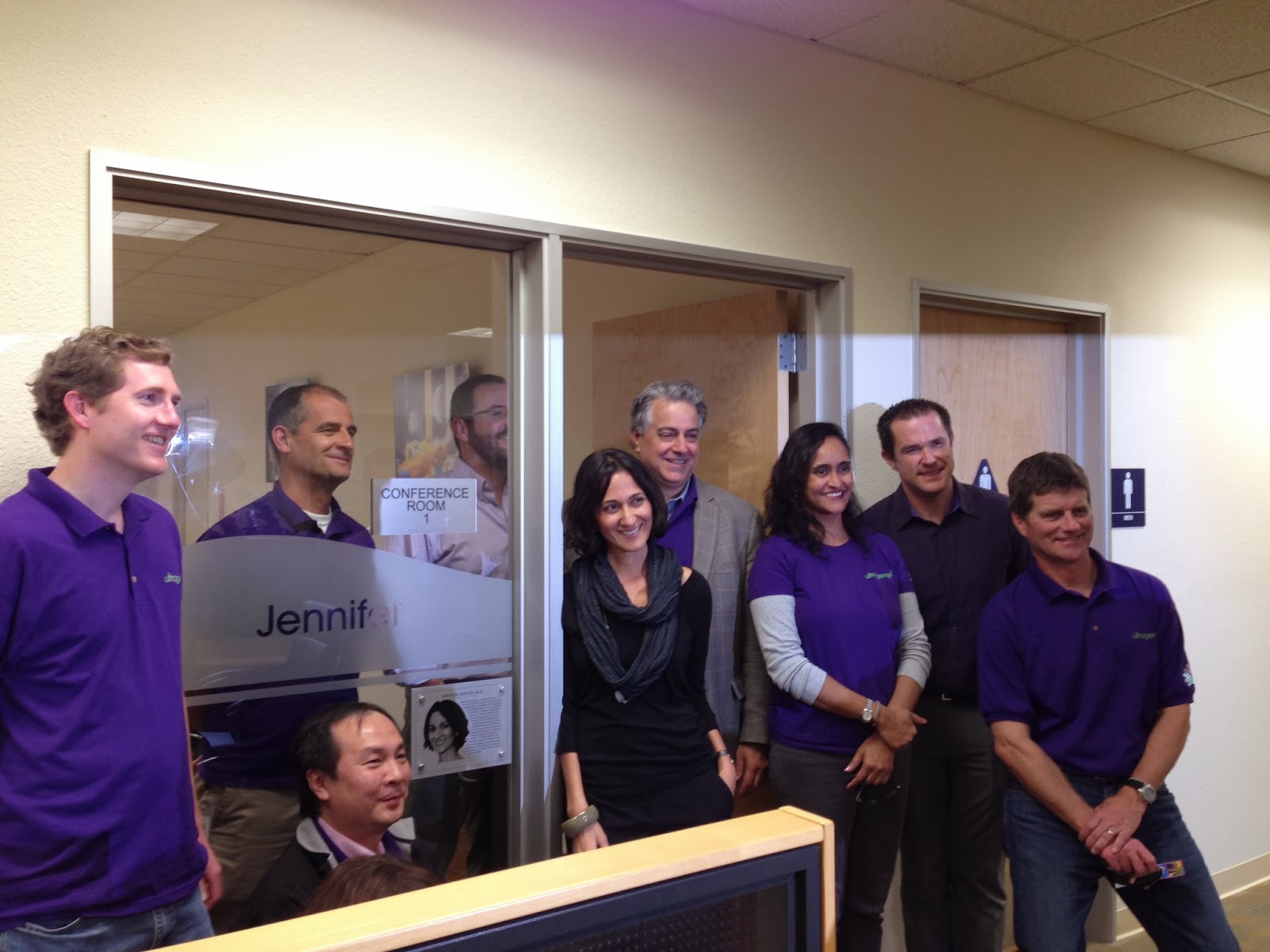
The Jennifer Room

About a month ago, I received an invitation to attend a "Patient Day" reception hosted by Dr. Emil Kakkis, CEO of Ultragenyx. Ultragenyx is the biotech company that is currently in phase II of a clinical trial for a potential treatment to slow the progression of HIBM.  Dr. Kakkis was throwing a party to celebrate the patients of the various genetic diseases he has helped treat over the years and to honor his incredible staff. He was also going to be dedicating conference rooms named in honor of patients. I was told there was one named after me. I hesitated at first as I am always a bit protective of my emotional reaction when spotlighted in the patient role, but I decided to go for it.

Getting there yesterday was a bit frustrating, between forgetting my driver's license (oops), traversing the long distance across the airport to the gate (still not ready to be pushed in a wheelchair) and battling the bay area traffic once we landed. And of course, driving across the Golden Gate bridge-the same bridge I used to regularly cycle across when training for the AIDS ride. All the while I was questioning whether any of this was a good idea, especially since I left two sick kids at home.

Eventually, we made it the party. And I was definitely not expecting what came next. There were actually no other HIBM patients. The majority of the patients there were teenagers who, with their families, were reuniting 15 years after Dr. Kakkis and his team literally saved their lives with his novel experimental enzyme therapy for their condition, MPS1- a progressive and fatal childhood metabolic disease.  We watched video clips of these patients as children, we watched the segment of the 60 Minutes interview with Dr. Kakkis and the families of those affected, we listened to him memorialize those children whom he could not save and I sat there, moved beyond words, in the company of a couple hundred people who were also in awe of what they saw. Then Dr. Kakkis put up a slide with a picture of me on it. (He had mentioned when I arrived that he would call me up on stage to say a few words (!). And the description he used to introduce me was "physician, patient, mom, speaker, patient advocate and blogger." The first four I could identify with, but advocate and blogger?  It may sound strange, but I've never really considered myself an advocate. Maybe because I still hold onto some guilt about never really jumping at the opportunity to meet another HIBM patient (still learning how to cope with seeing what's ahead of me) or maybe because I'm not actively posting/sharing on the Facebook page the way other patients do or maybe because I'm not on the NDF board nor do I involve myself much with it aside from the gala speech. And then there's blogger label. I guess I associate a blogger with someone who does it more professionally, someone who has paid ads on their site, someone who isn't as technologically challenged as to only be able to use Blogspot, the most remedial blog site around. And so when I got up to speak, I still didn't feel like I was the woman in that slide. And then, when that part was over, they took me upstairs.

Upstairs is where all of the offices and conference rooms are. As they directed me down the hall to the "Jennifer" room- photographer and videographer actively filming by my side-I started to notice that multiple people in their purple Ultragenyx t-shirts identifying them as staff/ team members were gathering around me. I soon learned that they were the specific group of scientists and researchers who were dedicating their days and nights to working on finding a treatment for HIBM. They looked at me with such compassion and kindness. They shook my hands and gave me hugs. I then quickly discovered that for most of them, I was the first HIBM patient they had ever actually met. And then many of them shared with me that they actively read my blog and that I am an inspiration to them and their work. It started to become surreal. There we all were, gathered around this room with my name etched in glass and a plaque of my picture and a description of me on it at the headquarters of a biotech firm in Novato, California. And in that moment, maybe for the first time, I stopped wishing that I had nothing to do with this disease/this conference room/ this trip and started fully accepting and embracing that this is my life and that as scary as it is to let that in, it feels good to know that I can. It feels good to realize that I am doing something bigger than and outside of myself. It was the first time that I started to see the broader implications of what I do. I was standing in front of people who are dedicating their lives to working on this orphan disease and I was sharing myself with them. As I stood in front of them, I told them how incredibly grateful I was for all that they are doing- not so much for me- but for my boys. Not surprisingly, I became emotional (as I always do when I think about HIBM and the impact on my kids), but surprisingly, so did so many of them. I didn't know that you could find the combination of so many brilliant minds and open hearts in one place.

I would be lying if I said I didn't fantasize about returning again in 15 years-just like those MPS patients- watching the video footage of me crying and speaking in front of that conference room yesterday and celebrating the fact that I am still not in a wheelchair- thanking Dr. Kakkis and his team for all they have done for HIBM. I don't fool myself into thinking there's any guarantee that that's going to happen. But I am starting to believe that I have a purpose in this life with this disease. Not in some grandiose or meant-to-be kind of way, just in the way that I can help others understand who we are and what we experience and how desperately we are in need of help. To think that I would have missed out on this experience had I let my vulnerability win...well, it's a reminder of what I always tell my patients: growth and comfort are on opposite ends of the spectrum.

I dedicate this blog post to Dr. Emil Kakkis and all of those miracle workers in their purple shirts at Ultragenyx. You know who you are.


Monday, August 26, 2013

Tired

I'm tired.
I'm over it.
I feel like it's enough already.
I've risen to the challenge, I've tapped into my inner emotional resilience, I've gained invaluable coping tools and I've been given the gift of learning to truly appreciate what I have. 

But now I'm  ready to be done. Ready to be done with this disease.  I'm ready to go back to my old life where I wasn't "amazing" and insightful but rather just a regular person with regular life stresses. I want to remember what it felt like to care about losing 5 pounds to fit into my "incentive jeans" or to be able to watch a sad movie without having it hit me so hard because I relate almost too well to it.

I wasn't planning on blogging tonight, but I received a phone call today from the prosthetist informing me that my new, unbelievably expensive custom- made silicone AFOs have arrived from England and they are ready for me to come try on. I have been fantasizing about these  since I was casted for them a month ago. I have been fantasizing about the world of possibilities they may offer. They are essentially like tight silicone socks that you velcro onto your feet. And they only come up to your ankle. That means there is no hard black carbon fiber riding up the back of your lower leg. That means you can squat down, sit on the floor with your legs crossed, wear them under your socks and shoes and most importantly for me, walk around "barefoot." I realize I'm using the "you" pronoun, probably because I'm so terrified that they won't work for me or be the magical addition to my life that I'm hoping they will be. It doesn't feel safe yet to believe they will do all of these things for me. 

I am trying to be excited, but the excitement is competing with a sense of doom. Because for now, it's just a different kind of brace, but next time it might be an appointment to be fitted  for a cane, then a walker, then a wheelchair, a neck brace, hand controls for the car, railings for the shower and an adjustable bed to help getting up easier... These aren't irrational fears that I have. These are the realities for so many of my fellow HIBM patients. This is what patients post  about on our Facebook support group-questions about who has used what kind of assistance device, who has noticed arthritic pain in their joints, who knows how to get disability benefits from the government and on and on.

The worst part is, I am someone who is regularly forced into this intense, dark emotional space. That's not who I am. At least it's not who I used to be. I miss being able to be my happy, carefree self at times like these. I am still reeling from the joy that was my 20 year high school reunion over the weekend. Seeing so many wonderful old friends. Some of who didn't even know about the direction in which my life had gone. I guess I didn't realize that night how refreshing it was to have my HIBM self be somewhat anonymous. To be lost in my old self, hear memories about her, be reminded of her. I guess I just wish the high from that could have lasted a little bit longer...