Those of you who have read my posts from the very beginning know that I was not always as open and honest and raw about my disease before I started blogging almost 3 years ago. In fact, for the first few years after my diagnosis, I couldn't even say the word "disease." I mean, I literally referred to it as "the thing" and then later on as my "condition" and eventually, my "disease." But even though I could finally call it what it was, which was definitely a step towards acceptance, that didn't necessarily translate into being ready to fully embrace it or move on to actually sharing it with others or speaking publicly about it. And I most definitely wasn't open to meeting anyone else with the disease or even reading or hearing about other peoples' symptoms. I have always allowed myself to go at my own pace when it comes to coping with HIBM. I have always owned up to the fact that for me, seeing other patients farther along the path of progression in a more disabled state only serves to increase my anxiety and interfere with my ongoing efforts to stay in the moment-every moment that passes- and not fast forward to what may come to pass. And that worked for a while. But eventually, that cost-benefit balance started to tip. The cost of not reaching out to others was outweighing the benefit of actually being able to relate to someone who truly understood my struggles. So I enlisted my sister's help. I had her post on what was then the HIBM Yahoo chat group on my behalf, with the sole purpose of trying to find me an age-matched, level of disease progression-matched, gender-matched patient. And she did. Her name is Harmony. I affectionately refer to her as my HIBM pen pal. She lives in Fresno with her husband and two school-aged kids and we are about the same age. I remember the first time Harmony and I spoke on the phone, rapidly firing questions at each other: What kinds of shoes work for you? How do you manage with your kids? Do you find yourself staring at and admiring peoples's forearms and calf muscles? How much do you really share with your husband? Do you try to protect your family like I do? Since that initial contact (and through the ease of the newer Facebook HIBM community) Harmony and I have stayed in touch. We have been on a similar course of progression and we have both felt so lucky that it hasn't been as rapid as some others in our community. We even met for dinner one night in LA when she was here.
And then a couple of weeks ago, Harmony posted this on the HIBM Facebook page, "I am picking up my new wheelchair tomorrow. I am glad that I will have one and will use it for "long" distances, but I am also very discouraged by the fact that I need it." I read it just before getting the kids to bed. I had no time to stay with it. Nor did I want to. So I just went about my business. I didn't speak of it to my husband until late at night. It's such a delicate dance to do with a loved one, wanting to let them in because you know they want to be there, but also wanting to protect them and not scare them. Wanting them to be aware of the reality, but also wanting them to stay in whatever denial it is they're in that may be helping them cope. I didn't cry when I told him. Instead, per my usual, I shared with him all of the evidence that supports why I'm doing well and why I'm so lucky because my progression seems relatively slow and why I don't need to be considering wheelchairs at this time. And when I stopped talking to him, I had an honest, slightly different internal conversation with myself. I acknowledged how much slower I am now, how much more often I lose my balance and how much more effortful and exhausting it feels to "run" a few errands at Century City mall these days. Mostly, it's my inefficiency that gets to me. I'm a multitasker at heart. I don't do well with down time. I have always had a tendency to pack in a lot in any given amount of time. I thrive off being able to check all the boxes on my list and then some, finishing up with just a minute on the clock. But now that my body lags so much farther behind my mind, I am finding myself getting increasingly frustrated. Of course, I only let that conversation with myself go on for so long before silencing it.
But as is true of any truth, it doesn't change, it doesn't go anywhere and eventually, it will rear its ugly head in your reality over and over again until you are forced to confront it. And confront it I did.
A couple of weeks ago, I became obsessed with purchasing a pair of simple, basic, yet fashionable and therefore expensive (but I'll justify any cost in these situations) sandals that I knew I'd be able to wear with my braces. Long story short, I finally located them on-line and anxiously awaited their arrival in time to wear with an actual dress for Passover seder. (I used to love to wear dresses and skirts, but now my usual go-to outfit is slacks with my required lace-up sneakers). I got such a boost just imagining walking through the fashion doors these would open up for me. I even got a pedicure in honor of the occasion. Once they were in my possession, I excitedly engaged in the somewhat ridiculous process of trying to slide my braces and my foot into a shoe that's usually not intended for such devices, enlisting the help of my husband. I quickly realized that it wasn't going to work with my carbon fiber braces but I was determined. I then pulled a different kind of plastic brace out of a pair of boots, ones that are intended for post-op patients on the orthopedics floor of hospitals who are doing rehab for their temporary foot drops. They are not meant for multiple wears and I saw how worn and ineffective they had become. But they are much lower profile braces than the big black ones. Unwilling to give up, the next day I called Hanger Orthotics (where I get my braces) and asked how much a new pair of those plastic braces would cost. I didn't have much time in the coming days to get across town, but of course, I raced over there on Monday after seeing patients and before leaving for seder.
They brought them out to the waiting room so I could try them on and went back behind the door. No one else was there. I pulled out the sandals, so excited to see how life-changing they would be. I jimmied my feet into them with the braces. I stood up, feeling triumphant. I took a few steps. I didn't want to admit to myself that they weren't much more supportive than the ones that I had thought were worn in. I took a few steps more and then suddenly, I tripped. I fell forward, hard to the floor. That is nothing new. But when I put my hands out to protect me, as we all do so instinctively, they slid out to the side and I landed directly onto my face. My forehead, nose and chin felt the cold hard merciless concrete floor that lived just underneath the thin layer of carpet. As I lay there, momentarily stunned both physically (I wondered if maybe I had had a concussion) and mentally, I immediately wished someone had been there in that moment. Not a personal person, but maybe someone who worked there. Someone who could come to my rescue. Someone who could witness what had just happened. Validate how incredibly scary and terrible that was. And then I quickly shifted to feeling relieved that I had been alone. As I slowly gathered myself up, still in shock of the helpless, vulnerable physical position I had found myself in, I felt grateful that I didn't have to bear any more embarrassment and awkwardness than I already felt in my own presence. I sat up in a chair. Still in a daze. A few minutes later, they came out and asked for my credit card. I went through the motions, thanked them for having them ready so quickly and slowly walked out to my car. Once inside, I didn't reach for the phone to share with anyone in the way that I so routinely do. In fact, it was one of the first times that I didn't. Instead, I started thinking about all of the falls people had written about on-line (over the years it has been harder to resist reading). Gashes to the forehead requiring stitches. Being stuck on the floor at home and having to wait until someone got home to help them up. I wondered what I would do if I were seeing patients the next day because I knew it would bruise (and it did). I wondered how much worse it could have been and potentially will be in the future. Then I just felt a wave of foolishness. What did I really think? That these shoes were going to make me able-bodied? That if I could wear sandals and feel pretty one night, it would be as if this disease wasn't be so bad? Temporarily didn't exist? I didn't beat myself up for very long. I no longer invest too much emotional energy in such acts. I have compassion for myself in the same way that I try to help my patients have compassion for themselves. I gently reminded myself that it makes perfect sense that I went on this whole crazy mission in an effort to simply find a way to cope. I didn't cry as I drove home. I couldn't. I had to rush home to my kids, get dressed and spend any spare time packing for our upcoming spring break trip up north. (More on that next time).
You may be wondering what I decided to wear that night. If you know me, then you know that I did in fact did wear those sandals and braces to not one, but two nights of seder. I definitely wasn't the most competent walker and I certainly had my moments of almost-falls, but I got to wear my pretty dress and show off my new favorite light blue nail polish. I am well aware that my stubbornness or vanity or denial might not make sense to some people. But I'm also even more well aware that my ability to pull off such stunts and the ability to even assert my stubbornness or denial is temporary.
I admire Harmony for her strength and courage. For confronting her reality head-on. For not letting her emotions interfere with her rational, practical decision-making process. For me, for now, I am just going to start by simply considering the idea of using a cane. Baby steps. At my own pace.
Friday, April 25, 2014


Thursday, April 3, 2014
An Open Letter to Equinox
Dear Equinox
Westwood:
I knew I was
fooling myself when I first took a tour of your gym 1.5 years ago and thought
that it would be a good idea for me to join- you know, given the 2 flights of
stairs just to get to the front desk and then another 2 flights of stairs to
get to the locker room. But I just couldn't resist- the incredibly convenient
location across the street from my office (and a mile from my home), the
almost-never crowded pool where I could start doing the long put-off aquatic
physical therapy exercises and of course, the unlimited access to Kiehl’s bath
products. I told myself I would build the stairs into my exercise routine
and that even though there was no elevator from the pool to the locker room, I
would manage. I wanted it so badly. I wanted to enjoy all of the benefits that
other people do from belonging to a fancy gym. I didn't want to listen to the
whispering voice in my head reminding me that I actually live
in a different body from all those other people. I didn't want
to miss out on yet another thing because of my disease. And so I joined.
Of course,
first thing I did was look into your elevator access. I was told there is one
elevator in the lobby of the building that lets out on the gym floor. I tried
it a few times, but quickly learned that it doesn't have its own call
button. This means that every time I
pressed "up" and the wrong elevator opened (I think there are 8 in
total), I had to wait to let that one close before pressing “up” again so I
could hope for the right one to open. I
move at a slower pace despite having the same time constraints as everyone
else, so all that extra waiting wasn't a feasible option. I decided I would rather spend that waiting
time holding tight to the railing and climbing up one step at a time to the
main floor.
When I had
inquired about access to the second floor pool on my tour, I was shown the
wheelchair lift from the first floor. But I had a hard time believing there
wasn't any access to the third floor locker room, so I contacted your manager
and discovered that indeed there is a service elevator from the first floor gym
(which houses the small workout area that I use) to the third floor. I was relieved
and excited to have this option, especially since I take off my braces when I
exercise and this would allow me to just walk a short distance without my
braces to get to the elevator and go up to take a shower. Until then, I had to
take them off to exercise, put them back on to go up the stairs, take them off
again once upstairs to shower and then put them back on again to leave.
But when I asked for access to the elevator, you told me that you were
not allowed to give out elevator key cards. But you said if I just walk back to
the front desk (which is past the elevator) to alert one of the employees, they
would be happy to walk back with me and call the elevator. As always in those
situations, I tried to respond positively. I didn't complain. I didn't
want to seem unappreciative. I didn't try to help you understand that having to
walk all the way back to the front desk while carrying my braces and my two gym
bags in my hands is actually quite difficult and scary for me. I didn’t tell you that how it feels to have
people stare at me while I do it. I didn't tell you how awkward and
uncomfortable it was to have to stand and make small talk with one of the
random front desk escorts until the elevator arrived. I didn't tell you
that it's frustrating to have to stand there and wait until someone's free and
able to pull away from the front desk to assist me.
Eventually I
mustered the courage to share that this plan wasn't working for me and after
some negotiating, you allowed me to exchange my car keys for the elevator key
card (for the one day a week that I need it) when I entered the gym so that I
could simply finish my work out and make my way over to the elevator on my own
time and with some dignity. That worked for a while.
And then
yesterday happened. A month ago when I asked for the key card, I was told that
you didn't have it anymore. You told me that a member must have taken off with
it because you couldn't locate it. I figured I could go without it and surely
it would be available the next week. And then the next week came. And another.
And another. No front desk key card. By then my strategy had been to try to
make arrangements with the maintenance man whom I'd befriended who is the only
other key card holder. I won't bother you with the stress that went into trying
to make sure he was at the right place at the right time when I needed to go
upstairs...
Finally,
yesterday, the fourth Wednesday that I showed up only to hear the same story, I
explained that this had gone on for too long and the excuses were no longer
acceptable. You apologized and said, yet again, that you're working on it and
that for today, I should call the front desk when I'm done with my workout and
you would come bring me the key card. Fine. Not surprisingly, when I called,
ready to go up and shower before rushing to pick up my son from preschool, the
woman at the front desk had no idea what I was talking about. I then got the
attention of the maintenance man and motioned to him from across the room, but
he motioned back that he didn't have it. I felt the anger and then the sadness
came flooding in. Exasperated, I gathered my things and prepared for the climb.
And then I
saw you near the stairs. You asked if I had received the card from someone and
I told you I hadn't. I told you that I didn't expect you to get what it was
like for me, that I didn't expect you to know that I was once like you,
able-bodied, that I never imagined I'd be this person having to nag for basic
rights to use a gym and get to the locker room easily just like all the other
members. I didn't expect you to understand how emotionally draining it is for
me, being constantly reminded of my new disabled life and how much extra effort
I’m forced to invest daily to keep it together. I didn't expect you to know
that there's only so much I can take before I break down. And so I broke down.
I walked away crying. I cried my way up each stair as I held onto the railing
hoping today isn’t the day I fall, and then I cried even harder alone in the
shower. I pulled myself together to leave and then cried when I saw one of my
favorite teachers at the preschool and she gently asked me what was wrong. I
cried when I got to my office and called my best friend and together we mourned
the ignorance and lack of compassion that sadly seems to be more the norm than
the exception. I cried in the afternoon when I met a dear high school friend
for coffee and she told me she believed in her heart that my progression would
never get so bad to the point of being severely disabled. And then I cried once
more in the comfort of my own home. That cry was for the weekend I just had.
An amazing, 24 hour resort getaway, just me and my husband, that was
infused with a quiet, scary, sickening awareness that my body's getting worse,
that it's getting increasingly harder to get out of a hot tub and walk over to
my towel or take a stroll on the grounds of a such a beautiful place. I get
that there are worse problems to have. But there are better ones too.
Part of me wants to quit. Just
cancel my gym membership and end this ridiculous but exhausting battle over
access to your facility. This same facility that is sometimes painful to be in
simply because I have to watch strong people getting stronger, while I get
progressively weaker. But if only it
were as easy as cancelling a gym membership to get some space from my reality. I know that I can’t quit any part of this –
not your gym, not this disease, not my will to go on. So I will fight on. But is it really too much
to ask that you look at me, hear me, and then extend me enough compassion and
human decency to make this even a tiny bit easier?
Thursday, March 20, 2014
To my fellow HIBMers who know these feelings all too well...
That feeling you get when...
...you physically can't move out of the way (as in, just side step) when someone's trying to get by and he or she thinks you're just being rude.
...there's an earthquake and you realize you are completely helpless to escape in that moment (let alone to be able to run to your kids when they may need you most).
...someone who's ahead of you (and maybe in a rush) is being kind by holding the door open for you and you feel terrible because they don't realize how long they will have to wait until you hobble your way over to them.
...you meet someone for the first time, e.g. in your new book club and you don't know how, when or even if you should or need to reveal this "secret" or plain simple fact about yourself and your disability.
...you meet someone new, whether it's sitting in a parents' meeting at school or swimming in the pool at the gym and eventually you know you'll have to get up and out and display your disabled body and awkward gait for everyone to see and you are once again reminded that you will never have the luxury of just being you rather than you with the disability.
... you're at the supermarket check-out and you realize you forgot to get something, but the line behind you is so long that you just accept defeat and plan to get it the next time.
Then there's the feeling you get when...
...you hire a ski instructor (who's not part of the adaptive ski program because they happen to be shut down for the few days that you're there) and you tell him you feel bad that he has to constantly take his skis and gloves on and off and then bend down to attach and detach the special hardware on your skis every time you get on and off the lift and his response is, "Are you kidding me? This is nothing compared to what you have to deal with on a daily basis."
...you've spent the last 7 years dreading the day when one of your sons would eventually have to help you physically in some way and it turns out it's actually not a burden for him but rather something he does naturally and with such pride.
...your receive weekly deliveries of fresh pomegranates seeds from your father and step-mother which they've spent hours processing for you because they want to ensure you're eating enough antioxidants.
...your mother and mother-in-law drop everything when you say your husband's on an urgent care shift and you need help with the kids.
...your mother and mother-in-law drop everything when you say your husband's on an urgent care shift and you need help with the kids.
...your husband surprises you and takes it upon himself to have railings installed on the sides of the two steps in front of your house that have been giving you trouble for a while, because you couldn't bring yourself to deal with it in any productive way.
...you discover a cute new pair of retro sneakers to add to your collection of lace-up shoes only and you get a boost.
...your preschool mom friends regularly check in with you at an indoor gym birthday party to see if they can help you out in any way.
...you travel through your life and realize that your highs are incredibly, unimaginably high and the lows are tragically, painfully low, and you conclude that you'd rather struggle to hold onto and experience all of it than settle for the alternative.
Friday, February 28, 2014
I'll Go On
Today is international Rare Disease Day. And on this rare, very rainy Friday in Los Angeles, what was most on my mind all day was the fact that before HIBM, I don't think I ever once thought to consider the impact the weather can have on the lives of people with disabilities. I don't judge myself for it. It's just one of those things that would likely never enter into one's mind unless or until one is confronted by it first-hand. I am lucky to live in Los Angeles, where the elements almost never work against me. And so it is probably because of the infrequency of such weather that it hits me as hard as it does and did today.
As I woke up to the sound of pounding rain on the roof, one of my first thoughts was what shoes I would wear as I trekked around town, getting everything done that I needed to today. I wondered if I would be more excited for the rain if it meant I got to pull out a pair of stylish, barely used rain boots from my closet. Or, any rain boots for that matter. (I have yet to find a pair of rain boots with a zipper down the back that would allow for me to insert my leg braces). When I arrived at my first destination and opened the car door, I took out my new umbrella in one hand while still sitting in the driver's seat (and while also holding my phone, talking to my sister in the other). I was running late for an appointment.The rain was coming down hard. In my old life, I would just press the little button on the handle to allow for the umbrella to open and be ready for use. But in my current life, my right thumb doesn't have the strength to push it down all the way and so as I'm getting soaked in the rain with my car door open, I had to abruptly hang up the phone, put everything else down and then use both thumbs to open it. This may sound like a minor inconvenience to some, but in that moment I am made acutely aware that even the simplest of physical tasks are challenging for me. I am frustrated, angry and sad that I have to tolerate this disruption, both on a practical and an emotional level.
Of course, then there's the business of not being able to jump over puddles or step up onto a curb easily to avoid the small river that forms between the street and the side walk...
But I will stop there. This is just a few minutes of the life of someone with a disability. And that's someone who is still relatively able-bodied. And who has so much farther to go. I am still at the beginning. This is nothing relative to what may be coming. There are HIBM patients using canes, walkers and wheelchairs, trying to navigate their way through slippery sidewalks or worse, being forced to stay home and not get to participate in their lives the way they wish they could. There are patients waiting out in the rain for public transportation because they no longer have strength in the muscles needed to drive a car themselves. The ones who have become even too weak use hand controls so as to preserve some independence.
So, where does that leave us? Where does that leave me?
I recently read an article in the New York times titled, "How Long Have I Got Left?" written by Paul Kalanithi, MD, one of the chief neurosurgical residents at Stanford. He shares his experience of being recently diagnosed with metastatic lung cancer. He describes what it's like to have to cope with confronting his own, very real mortality on a daily basis at age 36. In doing so, he refers to 7 words written by the playwright Samuel Beckett that have stayed with him since he had read them years ago as an undergrad: "I can't go on. I'll go on."
And much in the way that Paul Kalanithi was profoundly impacted by this simple phrase, I too have been holding it close to me. It has been incorporated into my armamentarium of coping tools. In fact, it's at the top of the list. Somehow, some way, we do it. We move forward. We endure the loss. We find the blessings and joy in our every day lives to balance the depth of the pain. We think we won't be able to handle the decades that are presumably ahead of us, but somehow the years pass and we're still doing it. Those of us with rare diseases don't have the luxury of knowing that there are billion-dollar pharmaceutical companies lining up to cure us the way people with lifestyle diseases, such as high cholesterol and hypertension do. We don't have the benefit of research institutes across the nation focused on curing our disease the way other devastating but at least much more common diseases do. We have to pull from all of the resources that we have within us. We have to cultivate our resilience in a way we never imagined we'd have to. We have to raise awareness. And we can never give up on believing that now matter how ultra-rare our disease is, there will always be hope. No disease can take that away from us.
I can't go on. I go on.
As I woke up to the sound of pounding rain on the roof, one of my first thoughts was what shoes I would wear as I trekked around town, getting everything done that I needed to today. I wondered if I would be more excited for the rain if it meant I got to pull out a pair of stylish, barely used rain boots from my closet. Or, any rain boots for that matter. (I have yet to find a pair of rain boots with a zipper down the back that would allow for me to insert my leg braces). When I arrived at my first destination and opened the car door, I took out my new umbrella in one hand while still sitting in the driver's seat (and while also holding my phone, talking to my sister in the other). I was running late for an appointment.The rain was coming down hard. In my old life, I would just press the little button on the handle to allow for the umbrella to open and be ready for use. But in my current life, my right thumb doesn't have the strength to push it down all the way and so as I'm getting soaked in the rain with my car door open, I had to abruptly hang up the phone, put everything else down and then use both thumbs to open it. This may sound like a minor inconvenience to some, but in that moment I am made acutely aware that even the simplest of physical tasks are challenging for me. I am frustrated, angry and sad that I have to tolerate this disruption, both on a practical and an emotional level.
Of course, then there's the business of not being able to jump over puddles or step up onto a curb easily to avoid the small river that forms between the street and the side walk...
But I will stop there. This is just a few minutes of the life of someone with a disability. And that's someone who is still relatively able-bodied. And who has so much farther to go. I am still at the beginning. This is nothing relative to what may be coming. There are HIBM patients using canes, walkers and wheelchairs, trying to navigate their way through slippery sidewalks or worse, being forced to stay home and not get to participate in their lives the way they wish they could. There are patients waiting out in the rain for public transportation because they no longer have strength in the muscles needed to drive a car themselves. The ones who have become even too weak use hand controls so as to preserve some independence.
So, where does that leave us? Where does that leave me?
I recently read an article in the New York times titled, "How Long Have I Got Left?" written by Paul Kalanithi, MD, one of the chief neurosurgical residents at Stanford. He shares his experience of being recently diagnosed with metastatic lung cancer. He describes what it's like to have to cope with confronting his own, very real mortality on a daily basis at age 36. In doing so, he refers to 7 words written by the playwright Samuel Beckett that have stayed with him since he had read them years ago as an undergrad: "I can't go on. I'll go on."
And much in the way that Paul Kalanithi was profoundly impacted by this simple phrase, I too have been holding it close to me. It has been incorporated into my armamentarium of coping tools. In fact, it's at the top of the list. Somehow, some way, we do it. We move forward. We endure the loss. We find the blessings and joy in our every day lives to balance the depth of the pain. We think we won't be able to handle the decades that are presumably ahead of us, but somehow the years pass and we're still doing it. Those of us with rare diseases don't have the luxury of knowing that there are billion-dollar pharmaceutical companies lining up to cure us the way people with lifestyle diseases, such as high cholesterol and hypertension do. We don't have the benefit of research institutes across the nation focused on curing our disease the way other devastating but at least much more common diseases do. We have to pull from all of the resources that we have within us. We have to cultivate our resilience in a way we never imagined we'd have to. We have to raise awareness. And we can never give up on believing that now matter how ultra-rare our disease is, there will always be hope. No disease can take that away from us.
I can't go on. I go on.
Friday, November 22, 2013
Guitars and Tombstones
Last Friday afternoon I was surprised to discover that my old acoustic guitar was in our living room. When I asked my son-who was playfully strumming the strings at the time- how it arrived there, he told me that my mom had dropped it off. She had apparently found it while cleaning out her basement.
I took a moment to figure out how I felt about it. I wasn't sure. I actually didn't want to feel any feelings about it. So I simply didn't let myself. I quickly moved out of any potentially emotional space and focused on how cute my son looked playing my guitar.
Throughout this last week, I've looked at my guitar from a distance. I've watched my two boys try to play it, bang it around, fight over it and simply enjoy having a "real" guitar in the home. The only time I actually let myself hold it in its proper playing position was to attempt to tune it. Then last night, after the boys and I had been messing around with it on the living room floor for a while, my husband called them into the bathroom for bath time. They ran down the hall leaving just the two of us behind-me and my beloved guitar.
I first started playing guitar as a sophomore in high school after years of playing the piano. I absolutely loved it. My guitar teacher would come over every week and fill my binder with some of my favorite songs. I especially fell in love with playing classical guitar. And I just felt cool playing the guitar. Funnily enough, though it was long before I had a husband or kids, I used to fantasize about how I would one day play to my future kids all the camp songs I sang as a kid. I dreamed about playing my favorite guitar song, “Blackbird,” for the baby I hadn't even had yet. I imagined jam sessions with friends as I got older; you know, the way cool middle aged folks do in the movies.
I can't pinpoint exactly when I realized my fingers on my left hand were too weak to bend far enough to actually press on the strings, but I know that at the time, I was so distracted by so many of the joys in my life, that I didn't really allow or feel the need to let it in. Plus, it helped that I had barely had time to play in the few years prior anyway.
But here I was, alone with my guitar for the first time in years, and I wondered. Is it possible that maybe my left hand's not as bad as I thought? Are there some chords that maybe I could play? Individual notes perhaps? So I let myself try. On some level knowing the outcome before I started, but also knowing I needed to test it out, one last time. I tried with my hand and fingers in every possible position. I tried to will my fingers to bend all the way. I tried to see if I could play with my guitar on the floor and my fingers coming straight down from above. I was operating in a very practical, intellectual, problem-solving manner. I wondered to myself what real guitar players do. Surely there are professional guitar players who succumb to rheumatoid arthritis or muscular diseases and still find a way to continue playing. I picked up my phone and found the number to The Guitar Center. I called and asked if there was a device or contraption that I could use to somehow extend my fingers/ help keep them in a bent position. "Nope, sorry. We don't have anything like that."
I hung up. And I sat there. I felt the feelings coming on but I quickly went through my mental files, trying to pull out the one that could help me defend against the pain that was slowly moving in: "I can still listen to music. I can still enjoy music even if I can't play it. I hadn't even played it for so long before my finger weakness, so what’s the big deal?..." I was desperately trying to reassure myself that it was okay. But it wasn't okay. It hurt. And then finally, I allowed myself to grieve. To mourn this loss. To erect a new tombstone in the cemetery of losses due to HIBM labeled, "Playing My Guitar." The truth is, though I already knew I had lost it, I hadn't yet allowed myself to go to the funeral. I hadn't been ready until last night. In fact, just last year, my sister asked if she could give my guitar to my niece who was ready to move on to a bigger guitar and I said "no," almost reflexively. I knew it didn't make sense to her and I also knew it didn't make any logical sense. The reality is, it had been in my mom's house for the last three years, it's not as if I was using it. But I just wasn't ready for that kind of acceptance. I was still too emotional about it to make a logical, rational decision. It was the same experience as when I finally donated my closet full of beloved clogs, sandals, high heels and flats. I had held on to them for years. They represented hope for me. Giving them away meant truly accepting I was never going to be able to wear them again.
Last night, I eventually let go of all that I had been holding in all week. I welcomed the tears. I knew that by letting them out, I would free up some of the emotional energy that had been invested in trying to prevent them from coming up and out. When my husband emerged from the bathroom and saw me on the floor crying with my guitar, I could see his pained heart and of course, the next thing he said was that we should just give it back to my mom. Oh how he would do anything to alleviate my pain. But of course, if only it were that simple. That route-the one of avoidance and disconnection- definitely has its place. But it's more of a way around it rather than through it. When you travel around it, it's still there, you're just trying not to look back at it because it feels too hard. But when you travel through it, you've seen and experienced it in all of its ugliness so that no matter how painful it is or was, there's no longer anything to fear. No question of what lurks in that deep dark space. You've made it out to the other side, alive.
I see how my kids enjoy having my guitar around, so for now I think I'll keep moving through it. I know that if I stay in it long enough, the intensity will dissipate and it will just be what it is. Another part of my story. Another piece to incorporate into my reality.
When my two beautiful, squeaky clean boys emerged in their jammies back to the living room, I brought them to the computer. I put them on my lap, opened up iTunes and clicked on “Blackbird.” I closed my eyes, held them tightly, turned it up and felt a wave of peace and fulfillment wash over me, learning once again that sometimes, there’s only one way to get there.
Wednesday, November 13, 2013
My speech from this year's NDF Gala
Below is the link to the speech I gave as an honoree at this year's NDF Gala at the Beverly Hills Hotel on October 17th, 2013. It was an incredibly successful event, selling out to over 600 guests and raising almost half a million dollars. Thank you to everyone who helped make it possible.
http://vimeo.com/79357093
http://vimeo.com/79357093
 |
Annual Neuromuscular Disease Foundation Gala. Jennifer's Speech
http://vimeo.com/79357093 |
Saturday, September 28, 2013
The Jennifer Room
About a month ago, I received an invitation to attend a "Patient Day" reception hosted by Dr. Emil Kakkis, CEO of Ultragenyx. Ultragenyx is the biotech company that is currently in phase II of a clinical trial for a potential treatment to slow the progression of HIBM. Dr. Kakkis was throwing a party to celebrate the patients of the various genetic diseases he has helped treat over the years and to honor his incredible staff. He was also going to be dedicating conference rooms named in honor of patients. I was told there was one named after me. I hesitated at first as I am always a bit protective of my emotional reaction when spotlighted in the patient role, but I decided to go for it.
Getting there yesterday was a bit frustrating, between forgetting my driver's license (oops), traversing the long distance across the airport to the gate (still not ready to be pushed in a wheelchair) and battling the bay area traffic once we landed. And of course, driving across the Golden Gate bridge-the same bridge I used to regularly cycle across when training for the AIDS ride. All the while I was questioning whether any of this was a good idea, especially since I left two sick kids at home.
Eventually, we made it the party. And I was definitely not expecting what came next. There were actually no other HIBM patients. The majority of the patients there were teenagers who, with their families, were reuniting 15 years after Dr. Kakkis and his team literally saved their lives with his novel experimental enzyme therapy for their condition, MPS1- a progressive and fatal childhood metabolic disease. We watched video clips of these patients as children, we watched the segment of the 60 Minutes interview with Dr. Kakkis and the families of those affected, we listened to him memorialize those children whom he could not save and I sat there, moved beyond words, in the company of a couple hundred people who were also in awe of what they saw. Then Dr. Kakkis put up a slide with a picture of me on it. (He had mentioned when I arrived that he would call me up on stage to say a few words (!). And the description he used to introduce me was "physician, patient, mom, speaker, patient advocate and blogger." The first four I could identify with, but advocate and blogger? It may sound strange, but I've never really considered myself an advocate. Maybe because I still hold onto some guilt about never really jumping at the opportunity to meet another HIBM patient (still learning how to cope with seeing what's ahead of me) or maybe because I'm not actively posting/sharing on the Facebook page the way other patients do or maybe because I'm not on the NDF board nor do I involve myself much with it aside from the gala speech. And then there's blogger label. I guess I associate a blogger with someone who does it more professionally, someone who has paid ads on their site, someone who isn't as technologically challenged as to only be able to use Blogspot, the most remedial blog site around. And so when I got up to speak, I still didn't feel like I was the woman in that slide. And then, when that part was over, they took me upstairs.
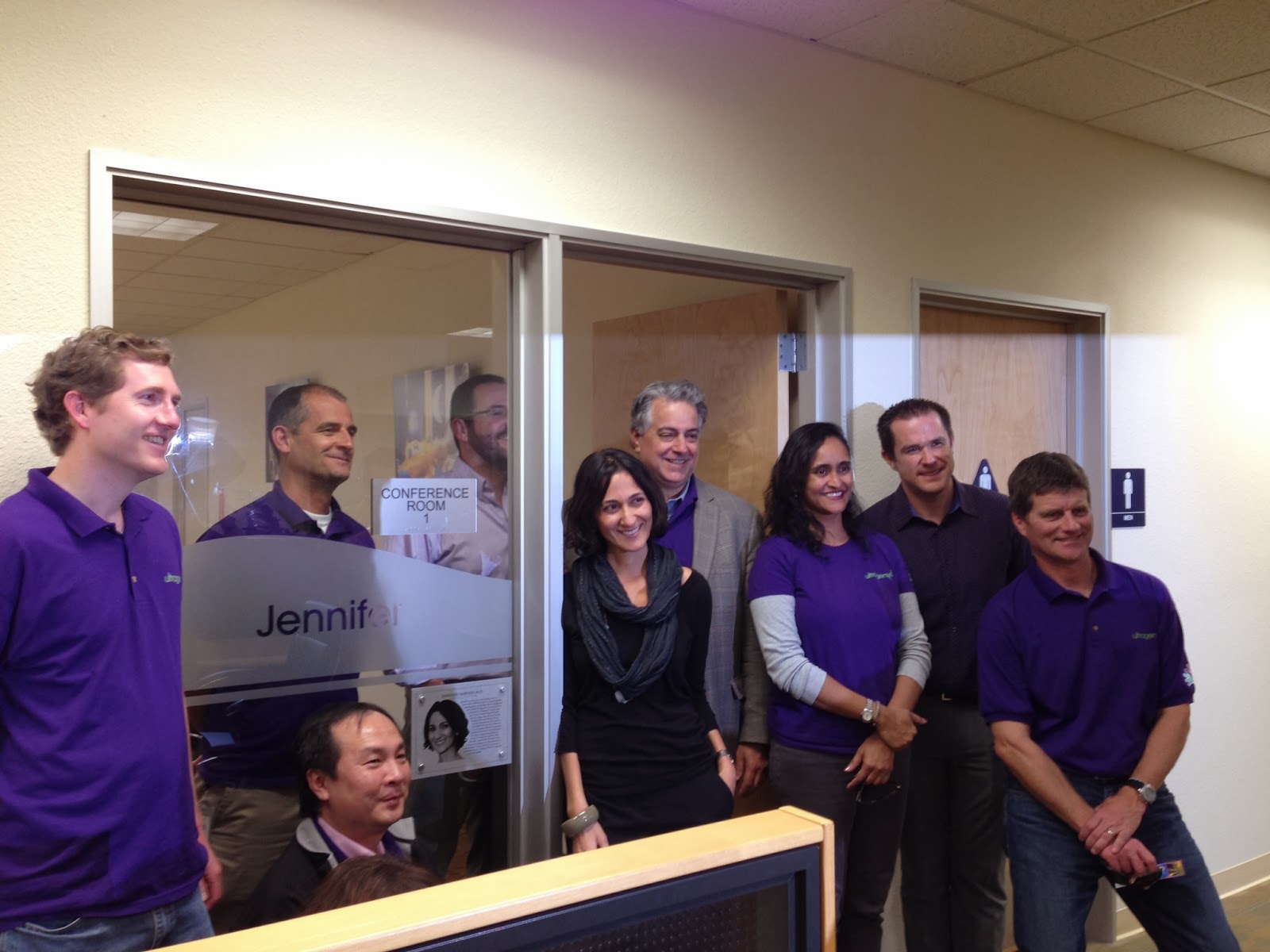
Upstairs is where all of the offices and conference rooms are. As they directed me down the hall to the "Jennifer" room- photographer and videographer actively filming by my side-I started to notice that multiple people in their purple Ultragenyx t-shirts identifying them as staff/ team members were gathering around me. I soon learned that they were the specific group of scientists and researchers who were dedicating their days and nights to working on finding a treatment for HIBM. They looked at me with such compassion and kindness. They shook my hands and gave me hugs. I then quickly discovered that for most of them, I was the first HIBM patient they had ever actually met. And then many of them shared with me that they actively read my blog and that I am an inspiration to them and their work. It started to become surreal. There we all were, gathered around this room with my name etched in glass and a plaque of my picture and a description of me on it at the headquarters of a biotech firm in Novato, California. And in that moment, maybe for the first time, I stopped wishing that I had nothing to do with this disease/this conference room/ this trip and started fully accepting and embracing that this is my life and that as scary as it is to let that in, it feels good to know that I can. It feels good to realize that I am doing something bigger than and outside of myself. It was the first time that I started to see the broader implications of what I do. I was standing in front of people who are dedicating their lives to working on this orphan disease and I was sharing myself with them. As I stood in front of them, I told them how incredibly grateful I was for all that they are doing- not so much for me- but for my boys. Not surprisingly, I became emotional (as I always do when I think about HIBM and the impact on my kids), but surprisingly, so did so many of them. I didn't know that you could find the combination of so many brilliant minds and open hearts in one place.
I would be lying if I said I didn't fantasize about returning again in 15 years-just like those MPS patients- watching the video footage of me crying and speaking in front of that conference room yesterday and celebrating the fact that I am still not in a wheelchair- thanking Dr. Kakkis and his team for all they have done for HIBM. I don't fool myself into thinking there's any guarantee that that's going to happen. But I am starting to believe that I have a purpose in this life with this disease. Not in some grandiose or meant-to-be kind of way, just in the way that I can help others understand who we are and what we experience and how desperately we are in need of help. To think that I would have missed out on this experience had I let my vulnerability win...well, it's a reminder of what I always tell my patients: growth and comfort are on opposite ends of the spectrum.
I dedicate this blog post to Dr. Emil Kakkis and all of those miracle workers in their purple shirts at Ultragenyx. You know who you are.


Getting there yesterday was a bit frustrating, between forgetting my driver's license (oops), traversing the long distance across the airport to the gate (still not ready to be pushed in a wheelchair) and battling the bay area traffic once we landed. And of course, driving across the Golden Gate bridge-the same bridge I used to regularly cycle across when training for the AIDS ride. All the while I was questioning whether any of this was a good idea, especially since I left two sick kids at home.
Eventually, we made it the party. And I was definitely not expecting what came next. There were actually no other HIBM patients. The majority of the patients there were teenagers who, with their families, were reuniting 15 years after Dr. Kakkis and his team literally saved their lives with his novel experimental enzyme therapy for their condition, MPS1- a progressive and fatal childhood metabolic disease. We watched video clips of these patients as children, we watched the segment of the 60 Minutes interview with Dr. Kakkis and the families of those affected, we listened to him memorialize those children whom he could not save and I sat there, moved beyond words, in the company of a couple hundred people who were also in awe of what they saw. Then Dr. Kakkis put up a slide with a picture of me on it. (He had mentioned when I arrived that he would call me up on stage to say a few words (!). And the description he used to introduce me was "physician, patient, mom, speaker, patient advocate and blogger." The first four I could identify with, but advocate and blogger? It may sound strange, but I've never really considered myself an advocate. Maybe because I still hold onto some guilt about never really jumping at the opportunity to meet another HIBM patient (still learning how to cope with seeing what's ahead of me) or maybe because I'm not actively posting/sharing on the Facebook page the way other patients do or maybe because I'm not on the NDF board nor do I involve myself much with it aside from the gala speech. And then there's blogger label. I guess I associate a blogger with someone who does it more professionally, someone who has paid ads on their site, someone who isn't as technologically challenged as to only be able to use Blogspot, the most remedial blog site around. And so when I got up to speak, I still didn't feel like I was the woman in that slide. And then, when that part was over, they took me upstairs.
Upstairs is where all of the offices and conference rooms are. As they directed me down the hall to the "Jennifer" room- photographer and videographer actively filming by my side-I started to notice that multiple people in their purple Ultragenyx t-shirts identifying them as staff/ team members were gathering around me. I soon learned that they were the specific group of scientists and researchers who were dedicating their days and nights to working on finding a treatment for HIBM. They looked at me with such compassion and kindness. They shook my hands and gave me hugs. I then quickly discovered that for most of them, I was the first HIBM patient they had ever actually met. And then many of them shared with me that they actively read my blog and that I am an inspiration to them and their work. It started to become surreal. There we all were, gathered around this room with my name etched in glass and a plaque of my picture and a description of me on it at the headquarters of a biotech firm in Novato, California. And in that moment, maybe for the first time, I stopped wishing that I had nothing to do with this disease/this conference room/ this trip and started fully accepting and embracing that this is my life and that as scary as it is to let that in, it feels good to know that I can. It feels good to realize that I am doing something bigger than and outside of myself. It was the first time that I started to see the broader implications of what I do. I was standing in front of people who are dedicating their lives to working on this orphan disease and I was sharing myself with them. As I stood in front of them, I told them how incredibly grateful I was for all that they are doing- not so much for me- but for my boys. Not surprisingly, I became emotional (as I always do when I think about HIBM and the impact on my kids), but surprisingly, so did so many of them. I didn't know that you could find the combination of so many brilliant minds and open hearts in one place.
I would be lying if I said I didn't fantasize about returning again in 15 years-just like those MPS patients- watching the video footage of me crying and speaking in front of that conference room yesterday and celebrating the fact that I am still not in a wheelchair- thanking Dr. Kakkis and his team for all they have done for HIBM. I don't fool myself into thinking there's any guarantee that that's going to happen. But I am starting to believe that I have a purpose in this life with this disease. Not in some grandiose or meant-to-be kind of way, just in the way that I can help others understand who we are and what we experience and how desperately we are in need of help. To think that I would have missed out on this experience had I let my vulnerability win...well, it's a reminder of what I always tell my patients: growth and comfort are on opposite ends of the spectrum.
I dedicate this blog post to Dr. Emil Kakkis and all of those miracle workers in their purple shirts at Ultragenyx. You know who you are.



Subscribe to:
Posts (Atom)